3D stereo anaglyph picture, use red blue glasses to view anaglyphic photo

3D stereo anaglyph picture, use red blue glasses to view anaglyphic photo

For the last year or so, 3D has been one of technology’s hottest topics, with the success of 3D movies paving the way for TV manufacturers, to the extent that two in five UK adults now express an interest in buying a 3D screen for their home. But what is the opportunity for mobile device manufacturers?

There has certainly been a lot of market activity (e.g. Sharp’s unveiling of a 3D mobile phone display) in anticipation of consumer demand, but will public enthusiasm migrate to mobile phone devices?

A recent GfK Technology survey, found that 12% of mobile phone users were interested in 3D photos and 8% were interested in 3D gaming. It is likely that the latter and any apps that embrace Augmented Reality or which offer the opportunity to enhance user generated content are going to drive most interest.

However, right now it’s a difficult call as to whether 3D on mobile will really drive the market. It’s up to the handset manufacturers to ensure the execution of the technology lives up to the hype.

To read a fuller article on this topic by Colin Strong, managing director of GfK Business & Technology, click here.

RESEARCH NOTES:

GfK NOP Technology conducted a survey among 996 UK adults in June 2010. The interviews were conducted online and are representative on UK adults who have access to the internet.

PHOTO COURTESY OF:
3dstereopics
http://www.flickr.com/photos/48057488@N06/4746599698/

  • Share/Bookmark

Mobile phone users under the age of 16 are extremely sophisticated, with deep brand experiences and preferences. This raises significant questions for network operators, handset manufacturers and service providers regarding how best to engage an increasingly important market segment. 

You could be forgiven for a sense of déjà vu. After all, rising mobile phone use amongst children is not a new phenomenon. As long ago as 2004 the Guardian was reporting growth in ownership amongst under-10s, [1] and media coverage concerning potential health concerns can be traced back even further. However, our ever-increasing reliance on, and immersion in, mobile phones and the digital services we use them to access, justify revisiting the topic. 

Recent data from GfK reinforces just how prevalent mobile ownership amongst under-16s has become (2.5 million 12-15 year olds, almost 9 in 10, now have one). Furthermore, this is the age group cementing the shift in behaviour from passive entertainment, such as television, to more active digital and online activities. [2] As such, it should come as no surprise that the value placed on their mobiles increases accordingly. 

It would be easy to assume these younger consumers are neophytes, new to the category with few preconceptions. Not the case. While 12-15s may be the first to acknowledge the importance of the technology, many of them are the same children the Guardian was reporting on five or more years ago. Instead, as many as 85% of those acquiring a phone are already on (at least) their second handset, and already hold the assortment of brand perceptions that follow this prolonged involvement in the category.[3] 

As established users, with a penchant for advanced features and functions (camera, music, and games usage are all high, alongside social networking, IM, and email), it comes as no surprise that entry-level handsets have limited appeal. While the majority (70%) of phones in this age group are being gifted, three-quarters (74%) of users were involved in the selection process, with medium and high-end handsets flourishing and above average spending. [3] Unsurprisingly therefore, style and functionality will be key to handset manufacturers, for whom it will be necessary to attract the end-user as much as the purchaser. 

The scenario facing operators is less clear. Selection of network and tariff, nominally a decision of less outward importance to younger consumers, remain primarily the domain of the purchaser (in contrast to handset, just 49% and 45% of 12-15 year olds influenced the choice of network/tariff respectively). How then, do operators approach these consumers? Given their focus on handset, clearly an appropriate and desirable range is a prerequisite. Beyond this however, high levels of gifting and relatively low interest in network/tariff imply it’s the gifter, as much as the end-user, who needs to be won over. 

Mary Robinson at GfK Telecoms Research Panels highlights the importance of the under-16 market for network operators: 

“Recent GfK findings for contract phones show that 83% of adults replacing their mobile chose to remain on the same network as before. With such high levels of loyalty in the adult market, the product propositions and brand experiences of the under-16s become massively important. Ignore them at your peril.” 

Ultimately, when this generation hits adulthood and consumption becomes self-sustained, they will already be sophisticated mobile users consuming a range of services and content. Harnessing their demand will be a key revenue stream in the future mobile marketplace, and the brand preferences already developing will play a significant role.

For handset manufacturers, operators and service providers, the prize is a significant one.

 For more information on the under 16 telecoms market please click here

[1] http://www.guardian.co.uk/technology/2004/apr/28/mobilephones.uknews

[2] http://www.statistics.gov.uk/cci/nugget.asp?id=2199

[3] GfK Research Panels: Kids Mobile Phone Market Report Q110

PHOTO COURTESY OF:

http://www.flickr.com/photos/uberculture

  • Share/Bookmark

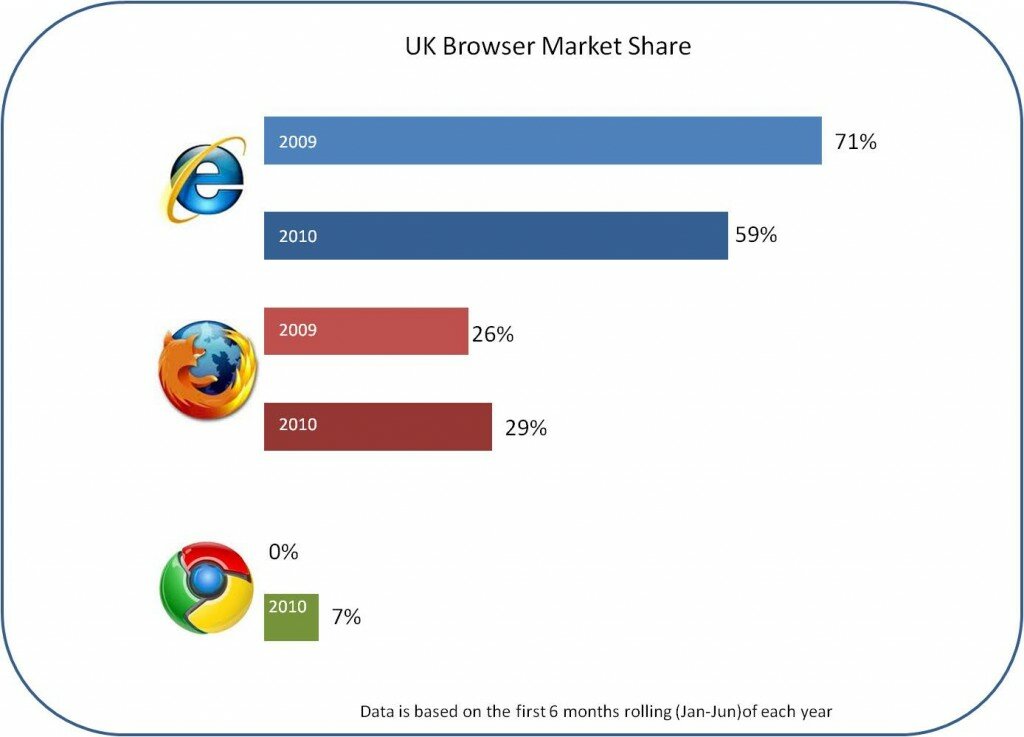
Google Chrome continues to muscle its way into the browser market as GfK data for January-June 2010 shows that it has a 7% share of the browser market. In June 2010 alone it accounted for a 9% share which is remarkable considering that it has only been in existence for 2 years.

To highlight the impact that Google Chrome is making we have compared Jan-Jun 2009 data against the same rolling months of 2010.

Compared to this time last year Internet Explorer has lost 12% market share while the Chrome and Firefox browsers have gained some ground. The bad publicity around Internet Explorer and its security flaws combined with the EU enforced browser ballot cannot have done Internet Explorer any favours. Google Chrome is taking full advantage and eating its way into Internet Explorer at a rapid rate and there is no doubt that they want to do the same to Firefox

Similar to our findings in the last browser update it is the younger age groups that continue to push Google Chrome. GfK data for June 2010 shows that 37% of Chrome users are aged 16-24. When considering that 70% of people in this age group spend 20 or more hours on the internet per week – there are a lot of hours being spent on the internet via Google Chrome.

Feel free to take a look at the latest GfK browser statistics here.

The GfK figures align closely with the figures reported by StatsCounter and Net Applications. Although GfK data is only based on UK browser market share it has an added advantage of also containing important demographic information which is unavailable elsewhere (age, gender, UK region, marital status, time spent on the internet). From our data we know that only 25% of people in full time education are using Internet Explorer. If you are interesting in getting some more of this data then please feel free to contact GfK NOP Technology.

How we collect the data

Each month GfK NOP conduct a UK based online survey among UK adults aged 16 and over. The sample is representative of UK adults who use the internet ten hours or more per month. It is important to note that we do not ask a question about which browser the respondent uses, instead, our servers determine the respondent’s browser used to complete the survey. This data is therefore more robust than stated survey data as it is based on actual usage.

Monthly sample size; June 2010 (n=1224)

Jan-Jun 2009 (n=5763)

Jan-Jun 2010 (n=7360)

  • Share/Bookmark