
 The pressure on offline retail is growing with online retail’s move onto mobile platforms creating instant price transparency. The GfK finding that customer journey patterns are mixing online and offline in the purchase process means that retailers now need to invest in a truly omnichannel approach where both online and offline retail complement each other. By taking this creative route, bricks and mortar will continue to have a successful role in the market for tech products.
Author Archive
Bricks & Clicks: the start of a budding relationship?
April 24, 2012 17:16 by Colin Strong and Friedrich FleischmannHow good are consumers at predicting what they will like?
April 19, 2012 14:13 by Colin Strong I am pretty convinced that the shiny new tablet PC I’ve been playing with in the shop around the corner from work will bring me a lot of satisfaction – just think of all the new things that I will be able to do…..and that new on-demand film service I signed up for at the weekend will make a family film night in easier and more enjoyable. In fact, a lot of the purchase decisions that I make are because I think they will make me happier. Our quest for future happiness seems to figure strongly in many technology purchases where consumers often make pricey investments in the belief that a new device or service will bring them happiness in the future.
This is typically relevant to discretionary purchases but the choices made within even non-discretionary purchases can be for this reason (e.g. by choosing this broadband supplier I will have greater peace of mind = happiness).
Experience or memory: which influences the way we think about brands?
April 5, 2012 10:17 by Colin Strong Think of your last holiday….did you put aside the camera in order to savour those special moments? Or did you take numerous photographs to capture the memories? When you returned home, how did those photos shape your memory of that holiday?
The reason I ask is because Behavioural Economics has recognised consistent differences between the way we report our experiences in the moment (such as whilst on holiday) and the way in which we subsequently recall our experiences (once we return from holiday). Daniel Khaneman, leading psychologist, calls these ‘two selves’ the ‘experiencing self’ and the ‘remembering self’ respectively. The distinction between the two selves has huge implications for consumer experience in areas such as service design and marketing.
Design goes subtle
January 17, 2012 15:27 by Colin Strong The look of mobile devices has changed considerably over the past couple of years, or more precisely since Jan 9th 2007 when the iPhone was first unveiled. Since then there has been a gradual movement toward the ubiquitous large touch screen, rounded corners and thin form. To illustrate this, handsets from Samsung, Nokia and Apple are shown to the left – to the untrained eye there is little to differentiate between them.
Compare this to a few years ago when there was a proliferation of form factor – from the previously ubiquitous clamshell Motorola Razor to some of the more unusual designs from Nokia (below). Admittedly these are somewhat polarised examples to make a point but nevertheless it is fair to say that we are not seeing the range of design in the basic form factor that was the case a few years ago. Some would consider that this was due to the focus moving to the user interface rather than the form factor of the device and indeed, as we have reported previously, technology eco-systems are increasingly the critical element of the design process.
Digital psychology: What Smart Data says about you
January 11, 2012 12:23 by Colin Strong
 As I started planning my summer holidays for this year (yes, I like to be organised) I was struck by the sheer scale of the digital footprint that I was creating. I used Google to search potential destinations, looked at travel reviews, local destination websites, tried to see what the apartment looks like using Google Earth, shopped around travel sites to book my airline, used comparison sites for my car hire and insurance, let everyone know about it on Facebook…and this is all before I even set foot outside of my house. When I finally go on holiday I will of course leave digital traces all the way to and from my destination (Italy as you ask) as I will inevitably access my emails when I am away, let alone be shown up on all manner of travel systems . When I get back I will be uploading your photos, sharing my thoughts online, updating Facebook again etc.
Charlie bit me: How can brands create viral marketing materials?
January 5, 2012 13:44 by Colin Strong (You can read the full version of this article in the latest edition of GfK TechTalk here.)
Most of us love getting a link to a piece of internet material which we find amusing and then forward on to our friends. It’s harmless and generally leaves us with a good feeling so it is easy to see why many brands are so keen to get in on the act. It’s also perhaps not unreasonable to expect digital viral material to potentially work well for technology companies given that the target market is likely to be spending more time online. Of course some brands do this extremely successfully, but many others try and fail – so what makes some succeed while others get consigned to the outer reaches of YouTube?
To try and answer this, I spoke to Dr Dominic Yeo, an academic at University of East Anglia with a particular expertise on this aspect of consumer behavior about research he had conducted whilst pursuing his PhD at Cambridge.
April 9, 2010 08:00 by Colin Strong
A recent UK study finds consumers have less faith in Facebook than either Microsoft or Google to keep their personal information private
Social networking sites typically involve disclosing often very personal information to your circle of friends and to this end, it is important to have faith that the social networking brand will respect the privacy of this information. Recent research by GfK Technology indicates, however, that Facebook has lower levels of trust in keeping personal information private than either Microsoft or Google. Given the remarkably high levels of usage of Facebook this is clearly a concern for the brand owners.
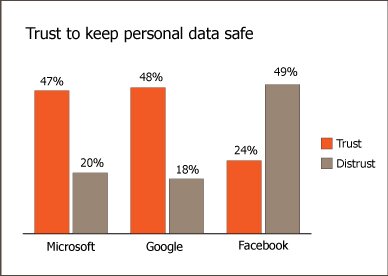
This illustrates the dilemma facing organisations such as Facebook – whilst consumer behaviour or personal information can be key to creating new services that are enjoyed by users, there is often a sense of unease about data being used in this way. Furthermore, as is likely the case with Facebook, the illicit activity of unscrupulous users of the service (such as those posing as friends in order to conduct fraud of some description) has a knock-on effect for the brand.
Will consumers rise to operators’ high hopes of a Apple App Store challenge?
February 25, 2010 12:59 by Colin StrongThe launch of the Wholesale Applications Community is potentially a substantial challenge from network operators to the dominance of Apple. Managing consumer demand and the consumer experience are likely to be key.

Recent news that 24 leading network operators are launching The Wholesale Applications Community, a mobile apps store which aims to make it easier for developers to build and sell apps “irrespective of device or technology”, begs the question of how consumers will respond.
It’s certainly a tough market for network operators with recent research by GfK Technology showing handset manufacturers dominating the apps market and indeed, a recent report by Gartner gives the somewhat startling statistic that Apple is responsible for 99.4% of mobile apps sales in 2009.
The four key factors that GfK Technology consider to be critical in driving the potential success of this sort of store are:
Apple Apps Store leads for mobile but market still open
February 15, 2010 09:27 by Colin Strong
We often seem to think that the Apple App Store has a dominant market position for mobile devices helped in no small part by the extensive press coverage it seems to attract. Recent research by GfK Technology (1,000 online interviews conducted in Jan 2010) suggests, however, that the apps store market is in reality more varied with a wide range of stores competing for business.
The Apple Apps Store does indeed lead the market but with 39% of consumers (that downloaded an application for their mobile device in the last 3 months) using it rather than a convincing majority. That’s not to say that they are better than other stores at extracting money from consumers or encouraging repeat visits but in terms of where individuals do their mobile apps shopping, they still have some way to go before taking the majority of the market.
Mobile advertising continues to build
February 4, 2010 16:55 by Colin Strong
Mobile devices continue to be a significant advertising channel according to recent research GfK Technology recently undertook in the UK. The proportion of consumers who had received some form of mobile advertising stood at 47%, fairly consistent with the findings from Q2 ’09. The big shift is perhaps the growth of iPhone as a staggering 84% of iPhone users say they have seen mobile advertising in the last 3 months vs. 45% of all other mobile phone users.
SMS continues to be the dominant form of mobile advertising with 38% of UK consumers receiving at least one in the last quarter. It’s therefore not surprising that network operators are putting significant investment into this area with O2 launching their SMS marketing service, More, in December and Orange partnering a trial with Blyk mid ’09.