Recent research conducted by GfK NOP shows that, among smartphone owners, mobile data allowance is more important than the network operator and the handset type.

From previous posts on TechTalk we’ve shown how the use of mobile apps shows no sign of abating and that the tight integration services on the iPhone drives Apple’s smartphone success. This thirst for apps and services is the reason why smartphone owners are placing greater importance on their mobile data allowance. Smartphone owners now rely on the services their phone provides and taking these away is not an option.

With many UK operators having recently capped their data allowances smartphone owners will think carefully about their next mobile tariff. GfK NOP estimates that 24 per cent of contract customers using smartphones would actually switch operators if they could get a better mobile data allowance elsewhere.

The decision to cap mobile data usage is a sensible one as the major UK network operators have millions of customers who depend on a reliable mobile network. However, in doing so, network operators need to consider the mindset of the consumer. The average mobile phone user including many smartphone users simply don’t know how much data they use. Those who require a data allowance will always prefer an ‘unlimited’ package for peace of mind. Now that ‘unlimited’ data is coming to an end, consumers will look for the safest option; in other words the operator offering the most generous package.

It is easy to see why smartphone owners react this way when you look at the level of importance they place on using services on their mobile phone. Table 1 (below), shows the level of importance consumers place on mobile services in their day-to-day routine:

Table 1: Importance of mobile service usage

There is clearly a stark contrast between the UK average mobile consumer and smartphone users. Given this huge difference in attitudes it is little wonder the extra emphasis smartphone users are placing on mobile data tariffs. The biggest challenge for network operators over the next few years is how they cope with the increasing demand for smartphones and the increase in data usage this will inevitably bring.

This research was conducted in association with Reuters who have published a thorough market analysis here

If you have any questions or comments regarding the research please click here to email us or leave your opinion in the comments section below

RESEARCH NOTES

  • Research was conducted by GfK NOP in association with Reuters between 16 – 19 July 2010
  • 978 interviews were conducted online among UK adults aged 16 and over. The sample is representative of UK adults with internet access.
  • Share/Bookmark

A recent GfK NOP Technology report shows consumers’ love affair with mobile phone applications has turned from a dalliance into a settled and dependable relationship. With a fifth of smartphone users downloading more apps than six months ago, mobile applications may soon replace browsers as the main gateway to the web for mobile phone users.

To read the full GfK NOP Technology report click here

  • Share/Bookmark

Growth returns to Western European consumer technology markets in Q1 2010. GfK TEMAX data shows that consumers are more willing to upgrade their home technology as well as experiment with new smartphone mobile technology.

GfK TEMAX data shows that, overall, the consumer technology market recorded 2.7% growth in Q1 this year compared to Q1 in 2009. Key technology sectors have recorded year on year growth, including Telecommunications (+4.9%), Information Technology (+3.6%) and Consumer Electronics (+0.7%) in Q1 2010. Smartphones, Windows 7 and LCD TVs are all driving factors of growth in their respective sectors.

Smartphones continue to drive growth in the Telecommunications market

While the telecommunications market declined by -3.2% in the fourth quarter 2009, the first quarter of 2010 returned to growth with a +4.9% increase year on year.

Growth in the telecommunications sector is being driven by the increasing demand for Smartphones as they make up 40% of the total sales value. In Western Europe one in five handsets sold runs a mobile operating system and uses a touchscreen or QWERTY keyboard as an input interface. Mobile Operating Systems include Symbian 60, Windows Mobile, Linux, Android, iPhone OS, RIM and Palm WebOS.

Internet access has become “ubiquitous” which is driving interest in mobile services to a much broader audience. Mobile email is becoming the alternative to the well perceived SMS services and navigation software often come pre-installed on the devices. Social networks have become the most popular apps on smartphones, adding more relevance and immediacy the PC at home. Furthermore, many of these mobile operating systems are also being used on netbooks and tablet PCs, which are being sold through network operators with 3G connectivity.

With a wide range of innovative, new smartphones showcased at the Mobile World Congress earlier this year and the recent interest in tablet PCs, growth in the telecommunications sector is likely to continue throughout 2010.

Windows 7 ignites upgrade cycle in the Information Technology market

The Information Technology market, the second biggest market behind Consumer Electronics in Western Europe, grew by +3.6% in Q1 2010 and is now worth EUR 11.5 billion.

Consumer demand is focusing on Mobile Computers, but also on accessories, peripherals, software and especially All-In-One-Desktop Computers too. The successful introduction of Windows 7 initiated a new replacement and upgrade cycle. Lots of consumers leapfrogged Vista, staying with existing installed hardware, software and even accessories and peripherals. Overlooking Vista led to many installed products being outdated upon the arrival of Windows 7, thus consumers were “ready” for an update. As consumers are becoming more aware, they are looking for a wide product range. As a consequence expectations for 2010 are positive following this trend in consumers’ attitude.

Strong demand for LCD-TV’s returns growth back to the Consumer Electronics market

Consumer Electronics, the largest technology sector in Western Europe, recorded year on year growth of +0.7% in Q1 2010. The impact of the recession on the Consumer Electronics markets no longer exists as demand for LCD TVs strengthens for three key reasons.

Firstly, most countries in Europe have a huge consumer demand for replacing the old CRT-TV with a new flat LCD-TV. Of course, the World Cup in South Africa is supporting this trend and quickening the desire to replace old TV sets. With the stabilisation of prices over the past months, the revenue situation also saw an improvement.

Secondly, the digital switch over is another contributing factor to the growth in this market. With analogue TV being phased out, new set top boxes or even a new TV set are required to receive digital TV channels. This development is most strongly observed in Spain (+16%), Italy (+6.9%) and Portugal (+4.4%). Home entertainment in general gained importance with better HiFi products or “TV ecosystems” becoming increasingly popular. Positive and substantial impulses were seen from Blu-ray, Home Theatre Sets, Loudspeaker Sets and of course High Definition set top boxes.

Finally, consumers’ willingness to invest in flat screens, HD and better sound systems for the home, is a clear sign of the “homing-trend”. This willingness-to-invest combined with the anticipated impact of the World Cup  gives reason to expect an even better second quarter 2010.

2010 consumer technology outlook is positive

In addition, GfK TEMAX covers other consumer technology sectors in Western Europe and all but one experienced growth. Other technology sectors that grew in Q1 were Photography (+2.7%), Major Domestic Appliances (+ 4.1%) and Small Domestic Appliances (+6.5%), but Office Equipment and Consumables sector contracted -1.2% compared to the same period in 2009.

These positive growth figures in Q1 are likely to continue throughout the year and Michael Sauter, head of GfK TEMAX, comments that:

“The first signs for April are looking positive. Our data show the Technical Consumer Goods market continuing on the road to recovery, indicating more growth to come in Q2-2010.”

Check back in July for the latest data and analysis from GfK TEMAX

ABOUT GfK TEMAX

GfK TEMAX® is an index developed by GfK Retail and Technology to track the consumer durables markets. GfK TEMAX® is published internationally. The findings are based on surveys carried out by the retail panel of GfK Retail and Technology. The retail panel comprises data from over 340,000 retail outlets worldwide. Click here for all reports and press releases

PHOTO COURTESY OF

http://www.flickr.com/photos/ndevil/

  • Share/Bookmark

Expect to see a vibrant and competitive tablet PC market over the next 12 months as Apple sell 2 million iPads globally in less than 60 days.

Apple certainly knows how to get the media and public excited about their latest creation, the iPad. Everyone is talking about the iPad and tablet PCs and this is not just tech press but also mainstream news bulletins. Apple is extremely proficient at sparking people’s imagination around all the creative ways their products, iPhone and iPad, can be used. Apple’s famous strapline for the iPhone was “there’s an app for that” which creates a powerful perception that anything is possible, and the same applies on the iPad.

Whilst Apple have created an enormous buzz around tablet PCs and educated the market as to all the potential uses, competitors will be launching rival products to compete with Apple’s iPad. In the next 12 months we’ll see a plethora of tablet PCs launched from a number of different manufacturers, running a number of different operating systems, from Microsoft Windows to various open source based platforms such as Android and MeeGo (Intel and Nokia joint venture).

The tablet PC market will be a place where laptop manufacturers and smartphone providers really start to compete head to head. At the smartphone end of the market expect to see Nokia, Blackberry and HP (running newly acquired Palm OS) launch alternatives to the iPad. At the PC end of the market the first entrant will be the Dell Streak which will quickly follow the iPad launch in mid June. Asus and Lenovo also have tablet PCs in the pipeline, which will most likely be based on Windows 7. Google won’t be left behind and will launch either an Android or even a Chrome OS based tablet during the course of the year.

With all the different tablet PCs, consumers will be spoilt for choice. Looking at the main three operating systems, Apple mobile OS, Windows 7 and Android/Chrome OS, each company will take a slightly different approach which will add great variety for consumers. For example, Google will be pushing for more of a cloud-based solution, Apple will be heavily app and services based while Microsoft will be evolving their traditional Windows based platform that everyone is familiar with.

As tablet PCs become more popular the netbook market will take a further nosedive. In July 2009 the netbook market grew an astonishing 641% but in April 2010 it grew only 5%, a remarkable fall from grace.

So if netbooks fall victim to tablet PCs, who will benefit?

Well, the iPad was launched in the UK last Friday and today Apple announced that they have sold more than 2 million units globally. According to GfK NOP Technology research Apple are expected to sell up to 2 million 1st generation iPads in the UK if they can meet high levels of early demand. The pricing of the iPad varies and is available as Wi-Fi only models as well as 3G devices from the major UK operators. Apple will almost certainly occupy the more premium end of the market, with competitor tablets likely to be more cost effective. However, price is not the only determining factor for success. The provider who can package up content and services that make tablets easy to use and relevant to the consumer will be the ones who come out on top.

Apple has proven credentials when it comes to delivering multi-media services and apps to their users. They’re not standing still either as Apple launched the iBookstore on the iPad which has already sold 1.5 million ebooks in the US. But even in the services market, competition is strong. Expect to see compelling service offerings from Google, Nokia, RIM (Blackberry) and HP Palm, all of which produce excellent hardware and are quickly improving their services and access to vibrant market places for 3rd party apps.

If competitor tablets can get their service offerings right we can expect to see a very competitive and exciting tablet market in the next 12 months.

FURTHER READING

Apple struggling to cope with demand

http://technology.timesonline.co.uk/tol/news/tech_and_web/personal_tech/article7134564.ece

Operator tariff prices

http://www.guardian.co.uk/technology/2010/may/10/o2-reveals-ipad-data-plans

2 million iPads sold globally

http://techcrunch.com/2010/05/31/apple-sold-2-million-ipads-in-59-days/

RESEARCH NOTES

GfK NOP Technology conducted a survey among 1279 UK adults between 16th and 21st April 2010. The interviews were conducted online and are representative on UK adults who have access to the internet.

IMAGE SOURCE

http://www.flickr.com/photos/jliba/

  • Share/Bookmark

Social media campaigns via popular sites like Facebook may be able to get ‘Rage Against The Machine’ to Number One in the music charts but they will have little influence on the outcome of the 2010 UK general election. In contrast, the televised election debates will prove a powerful platform for the three main political parties.

GfK NOP Technology research conducted online (so we would also expect a skew towards online sources) shows that TV debates have the most influence on how we vote as a nation. Despite the fieldwork for our survey being conducted after only the first of three televised debates on 16 April, they are still the number one source of information for the election on 6 May.

As an example of this contrast, official viewing figures suggest that around 8.4m viewers watched the third debate, vs. 3.2 m UK visitors to the BBC news website (with 350,000 streaming the debates online).

Interestingly, a similar number of people had watched party political broadcasts and election news (45%) as the TV debates (49%) but their influence varies considerably. Of those who watched TV debates 26% said that they had had the biggest impact on who they would vote for. Conversely, for party political broadcasts or election news on TV, this fell to just 10%.

In an election where it is becoming increasingly difficult to differentiate between the parties and navigate through the spin, the TV debates have provided a platform for UK voters to truly assess each party. The TV debates put the party leaders on the spot, not in terms of questioning, (I’m sure they’re fully briefed) but in the way they respond to each other.

Debates offer the chance to see the personality behind the policy (or perhaps a carefully sculptured version of that image), which is more than can be offered by a written press release. Although the three candidates are still mainly dealing in easily-digestible sound bites, the televised debates offer those members of the public who perhaps don’t have the time or the inclination to read the manifestos in depth to get a grasp on the key issues.

In contrast, internet sources lack the ‘live’ human connection the TV debates provide. Twelve per cent of the UK have read election news via broadsheets’ online news websites, but only  two per cent of this group say that it was the biggest influence on their vote. The main social media site to register any influence was Facebook, where six per cent of people had discussed politics, but only one per cent of this group said it was the most influential source of information about the election.

The lack of influence from social media could also be down to a lack of investment and understanding. The Conservative Party have probably considered this medium the most, but overall, all three main parties’ online and social media strategies are pretty poor. For example, there are no obvious attempts to link social media platforms, like Facebook, to party promotional material. Furthermore, Labour MP Stuart MacLennan showed a complete lack of understanding about how Twitter works (you say things that are controversial… it spreads pretty quickly) and was consequently sacked for inappropriate comments.

Whether it’s a lack of interest from the public or a lack of understanding by UK political parties, online and social media will have little influence on how people vote on 6 May. Despite this, we strongly believe that new media will play a bigger role in future elections, just as it is increasingly influencing other areas of society.

For all those interested in the data from this survey you can view it here

RESEARCH NOTES:

GfK NOP Technology conducted a survey among 1279 UK adults between 16th and 21st April 2010. The interviews were conducted online and are representative on UK adults who have access to the internet.

  • Share/Bookmark

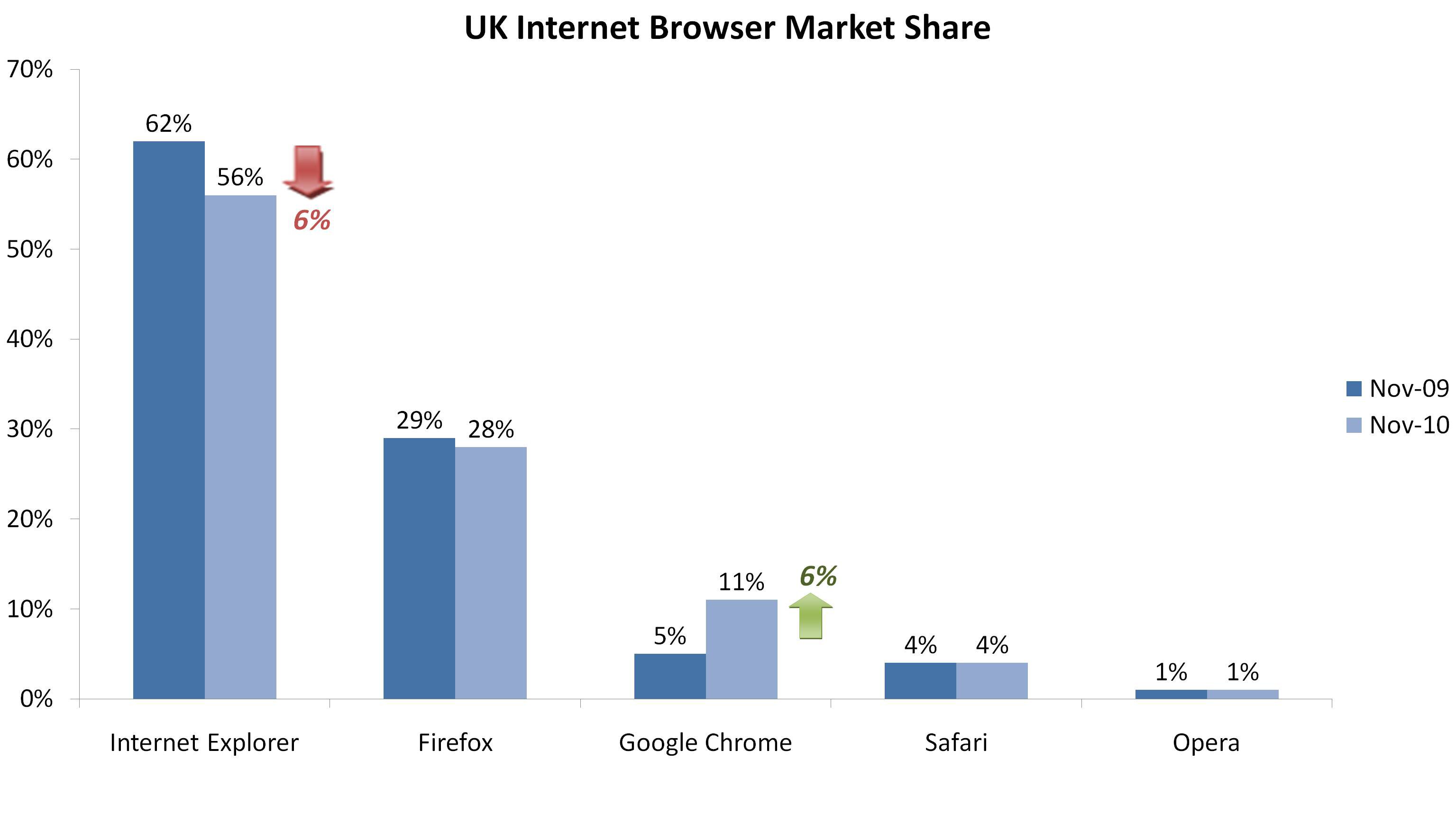
Since Windows introduced a browser ballot at the start of March, GfK Technology research shows that Internet Explorer has lost market share in the UK. Google Chrome and Mozilla Firefox have been the main beneficiaries of this new EU enforced regulation.


It was inevitable that Internet Explorer would lose some of its market share when its users were offered alternative browsers at the start of March. The EU thought it was essential that consumers should be offered a choice of browser, to stimulate competition in the browser market.

Early data suggests that when faced with an option, UK consumers have opted for an alternative browser. As we approach the end of March we can see that since the beginning of the month Internet Explorer’s market share in the UK has dropped 5%, with Google Chrome and Firefox each gaining an additional 3% market share.

We will continue to track the developments of internet browser usage over the course of the year so check back for more data and analysis over the next few months. If you’re interested, GfK Technology has been tracking consumer usage of internet browsers since the start of 2009 and we have created a shared Google document with our latest data here

How we collect the data

Each month GfK NOP conduct a UK based online survey among UK adults aged 16 and over. The sample is representative of UK adults who use the internet ten hours or more per month. It is important to note that we do not ask the question directly, instead, our servers determine the respondent’s browser used to complete the survey. This data is therefore more robust than stated survey data as it is based on actual usage.

Monthly sample sizes were as follows; February (n=1231) and March (n=1226)

  • Share/Bookmark

Availability of games still the biggest driver of hardware choice amongst gamers, but how is this going to change in today’s digital world?

With console manufacturers increasingly shouting about accessories such as motion sensors, blu-ray drives, huge storage capacity for media and a variety of online options for their new hardware, it’s important to reflect on the key reason why consumers buy consoles in the first place.

A recent survey by GfK Technology indicated that the list of games they can access is still by far the biggest driver when deciding which console to purchase next – 73% cited the range of games as the most important feature in influencing their next console choice.*

With this in mind, we thought we’d take a quick look into the software side of video games and try to predict how things will develop in the short term. Having asked a series of dedicated gamers, here are our three favourite ideas:


1. Trading of digital games

A platform where gamers are able to buy, sell and trade digital games.  With digital games becoming more freely available (research by NPD shows that 20% of games are purchased digitally by online gamers)  through the likes of PlayStation or Xbox’s online store, but the price of games increasing, it seems inevitable that gamers are going to look for ways to share titles between them (similar to the large second-hand market in gaming stores across the land).   This may not seem like an appealing idea for software developers, but if it can happen in a tightly regulated environment with the software developers heavily involved, they can look to take a small percentage of any trade that takes place. This would mean the revenue from any games could be continually renewed, with the added benefit that it keeps the market fresh for gamers.

2. User generated games/ open marketplace

As an extension, a trading platform for games, could also be used for developers (be they small independent companies or a lone programmer in his bedroom) to develop and sell a wide array of new titles. Apple has already proved the success of a similar model with their App store. Such an approach would ensure that all niche gaming interests are catered for and developers can compete to come up with more innovative titles. The result? Gamers get access to the wide, continually updating range of games that they desire, while the owner of any such platform could again be rewarded from a small percentage of any sale.

3. Innovative gaming

Of course, the most important aspect must continue to be the quality of the games themselves. As Heavy Rain has so spectacularly shown, games can be designed with a specific target audience or interest group in mind, offering up a more ‘sophisticated’ experience, worlds apart from the instant thrills of a first person shooter.

And for developers, the inherent risk in developing such ‘different’ gaming propositions as Heavy Rain is, well, perhaps not such a risk any more. GfK’s study has shown that approximately 70% of UK households now have access to some sort of gaming platform; offering software houses a huge potential gaming audience from the dad on his interactive murder mystery movie title, the mum on the Wii-fit board, the teenage son on the first person shooter and the pre-school daughter with her first pet simulator.

Let’s hope that games such as Heavy Rain receive the success they deserve and that from a gamer’s perspective the game trading platforms and third party marketplace emerge as feasible business models. I know that I for one would encourage any developments in these areas.


*That list of drivers to purchase:

Most important features in influencing purchase decision when come to buy a new games console

  • Range of games available   - 73%
  • Brand of console manufacturer – 31%
  • Hard drive/storage for media such as films and music – 29%
  • Motion sensor accessories (e.g. accessories that recognise movement and allow you to control games with your body) – 27%
  • HD video playback/ Blu-ray player – 23%
  • Ability to download games directly to your console – 23%
  • An ability to play games online with others in different parts of the world – 22%
  • An easy web browsing service – 18%
  • Access to video on demand services over the internet (similar to BBC iPlayer) – 14%
  • Compatibility with 3D video content – 9%
  • Access to your favourite social networking services – 9%
  • Access to movie rental / download services – 9%

Research Info

*1000 online interviews were conducted by GfK NOP among a UK representative sample of internet users. The fieldwork was conducted between 15th – 19th February 2010

  • Share/Bookmark

The mainstream consumer generally opts for a device that integrates lots of functionality. If the ‘third device’ with greater functionality does take off, eBook readers will, more than likely, become a niche product.


I love the idea of an eBook reader especially one with an ‘always on’ 3G connection. The battery life is superb, lasting in many cases well over a week and the e-ink screens are almost essential for prolonged spells of reading. I like the idea of receiving my favourite newspaper and other magazine subscriptions directly to a device all ready for my morning commute.

However, my desire to own an eBook reader is not driven by a personal urge to carry around a library of novels.  It is actually for business purposes. I could make better use of my commute by catching up on the news and reviewing work documents. Indeed, having access to meeting documents or presentations on an eBook reader whilst travelling to a meeting would be highly convenient.

It’s encouraging for eBook readers that sales of them in the USA are supposedly strong. Barnes and Noble’s Nook quickly sold out and Amazon’s Kindle is their “number one best-selling” product on Amazon.com. However, no one is sure how many eBook readers have been sold due to the secrecy of the sales figures, particularly from Amazon. Now with the arrival of tablet PCs, especially Apple’s iPad, eBook readers face stiff competition.

As a result, I fear that interest in eBook readers will be limited to two types of users; business people and extreme reading enthusiasts. If there is a big uptake in consumer demand for a ‘third device’ (i.e. something that sits inbetween a smartphone and a laptop) then I believe that the large majority of people will opt for a device that has multiple uses.

We have already seen that those who have experienced the benefits of an iPhone (and its  seemingly unlimited uses) are highly interested in tablet PCs. Now that the dust has settled on the announcement of Apple’s iPad, many commentators believe its success will rely on the consumer being able to tailor the device to their own specific needs. Further to this, others are already excited at the new applications the iPad will enable.  One of my favourites is to use it as a board game.

The specialist nature of eBook readers seem to be reflected in interest levels among UK consumers. Prior to Apple’s announcement of their iPad, GfK Technology research showed that interest levels in eBook readers (23%) was half that of tablet PCs (45%). Perhaps not surprisingly, interest levels for eBook readers are higher among those who had recently bought either a physical newspaper or a book.

It is my view that the success of a product is highly dependent on the problem it solves or the demand it satisfies. History has shown that those devices that satisfy numerous need states naturally succeed, limiting specialist devices to a niche audience.

NOTES

Photo courtesy of:


Research Info

*1000 online interviews were conducted by GfK NOP among a UK representative sample of internet users. The fieldwork was conducted between 15th – 19th January 2010

  • Share/Bookmark

GfK NOP research shows that consumers familiar with the iPhone are much more interested in tablet PCs than the average UK consumer and, what’s more, they know exactly what they would use it for.


One of the hot topics at this year’s CES (Consumer Electronics Show) was tablet PCs. Microsoft showed off Windows 7 (multi-touch version) on an HP tablet and, despite Apple’s non-attendance, there was much hype around a potential ‘iPad’ (iSlate, iTablet?). Many believe that the hype will become a reality on 27 January when Apple hosts an event entitled ‘Come see our latest creation’.


What interests me most about tablet PCs is who would buy one and what they would do with it. Recent research*conducted by GfK NOP shows that interest levels in ‘tablet PCs’ for the average UK internet user are at moderate levels with 45% being somewhat or extremely interested. That may sound high, but with all research like this, sales never match intent. However, the most striking finding from this research is that levels of interest are significantly higher among iPhone users – at 75%.

Those Interested in Tablet PCs

Why such a big difference? Well, iPhone users will be familiar with features such as multi-touch screens, integrated multimedia services and, of course, the App Store. This, in itself, begins to reveal what consumers will use a tablet PC for. In a way it is obvious for an iPhone user that an iPad (let’s go with that name for now) would be a larger, more powerful iPhone, which would be a natural choice for web browsing and multimedia as well as being extremely customisable with apps. The research supports this view because of those interested in tablet PCs, 58% of iPhone users (41% UK average) said they would use it for an ‘enhanced’ web browsing experience and 75% of iPhone users (41% UK average) said they would use it as a portable multimedia player, two of the top answers.

However, web browsing and multimedia are standard features for PC, laptop or even netbook users, so will the introduction of the tablet PC enable new and different uses? Reading between the lines, Apple’s invite (pictured below), with the splashes of paint used in the imagery, might suggest that a future iPad will be a more effective platform for creative tasks. Over half of iPhone users interested in tablet PCs (51%) said they would use it for ‘mainly creative tasks like editing photos or drawing images’ compared to just 27% as a UK average. Although tasks like these are becoming more mainstream, the tablet PC, especially an Apple one, could accelerate that trend.

Potential effect of tablet PCs
For some time now, people have been calling for Apple to release a netbook, mainly because many wanted a portable Apple experience with web browsing and multimedia capabilities. In a way the iPhone has filled this void but a future iPad could take the experience one step further and, as we’ve seen, iPhone users agree. The obvious difference is that a netbook and a tablet PC will sit at different ends of the affordability scale. Apple’s products are always at the premium end of the market and are about delivering a simple and high performance user experience. A tablet PC has the potential to meet all of those criteria without devaluing their product pricing or risking customer satisfaction as they may have done with a netbook. With this is mind, I can now see why they resisted netbooks and waited for tablet PCs despite the prolific sales netbooks received over the past few years.

Whether tablet PCs will have an effect on netbook sales is hard to tell, especially as they will (almost definitely) be at least twice the price of a netbook. One risk Apple and other PC manufacturers might face is the cannibalisation of home laptop sales. Of those interested in tablet PCs, 60% of iPhone users (48% UK average) said they would use it to replace all the tasks of their home PC or laptop. This is not as unbelievable as it first sounds given that the majority of home internet users (58%) only use their PC for basic tasks like browsing the internet.**

It’s no wonder so many people are excited about the potential of a future iPad being announced later this week. Apple have an incredible knack at educating consumers about their new products before anyone has even seen what they look like. They did the same with the iPhone; Apple let the market speculate about what it would look like and what it would do before it was even announced. The success of the iPhone has sparked consumer interest in the iPad and the same seems to be happening again. For iPhone users in particular an iPad is simply a complimentary and natural evolution of the iPhone.

So, will the tablet become as common an item on the coffee table as a magazine or a book?… We’ll have to wait and see! Roll on 27 January!

NOTES ON THE RESEARCH

*1000 online interviews were conducted by GfK NOP among a UK representative sample of internet users.
  • Share/Bookmark